Machine Learning: Decision Trees & kNN
INS-605: Data Analysis II

helpful resources
🌐 Ch 14, Pattern recognition and machine learning, Christopher M. Bishop (2006).
- Great! A bit theoretical but very comprehensive.
- Good for analysts/thinkers.
🌐 Ch 9, The element of statistical learning by T. Hastie, R. Tibshirani & J. Friedman (2008).
- Great one of all times.
- Good for analysts/thinkers.
1.1 What’s Machine Learning?
- Machine Learning A field of study that gives computers the ability to learn from data.

- Supervised Learning: Works with labeled data \((X,Y)\), aiming to predict \(Y\) using \(X\).
- Unsupervised Learning: Works with unlabeled data \((X)\), aiming to reduce dimensions, discover patterns or structure in \(X\).
- Reinforcement Learning: Works with agents that learn to make decisions by interacting with an environment, aiming to maximize a reward signal.
Supervised Learning Problems
- In Supervised Learning, we learn to predict the target \(Y\) using \(X\).
- Regression: \(Y\) is a continuous variable.
- Classification: \(Y\) is a categorical variable.
- Choosing a model means selecting a function that maps \(X\) to \(Y\).
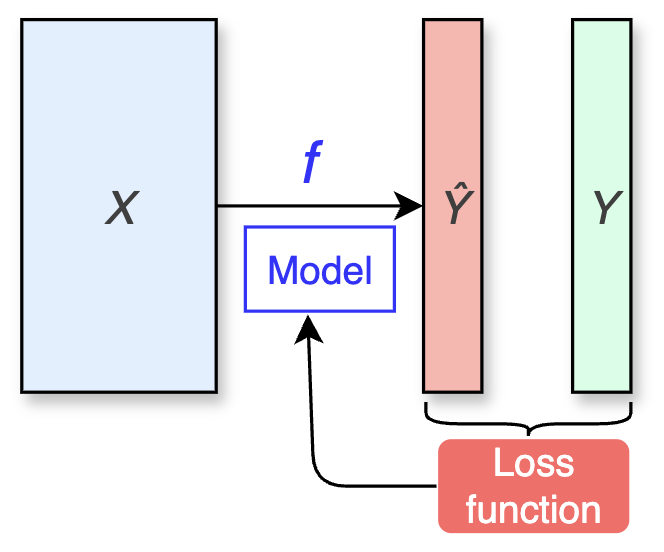
- Loss function: quantity that measures the error between the predicted \(\color{red}{\hat{Y}}\) and the actual \(Y\).
- Supervised Learning Objective: search for model \(f\) with smallest
average loss function.
3.3 Fine Tuning k
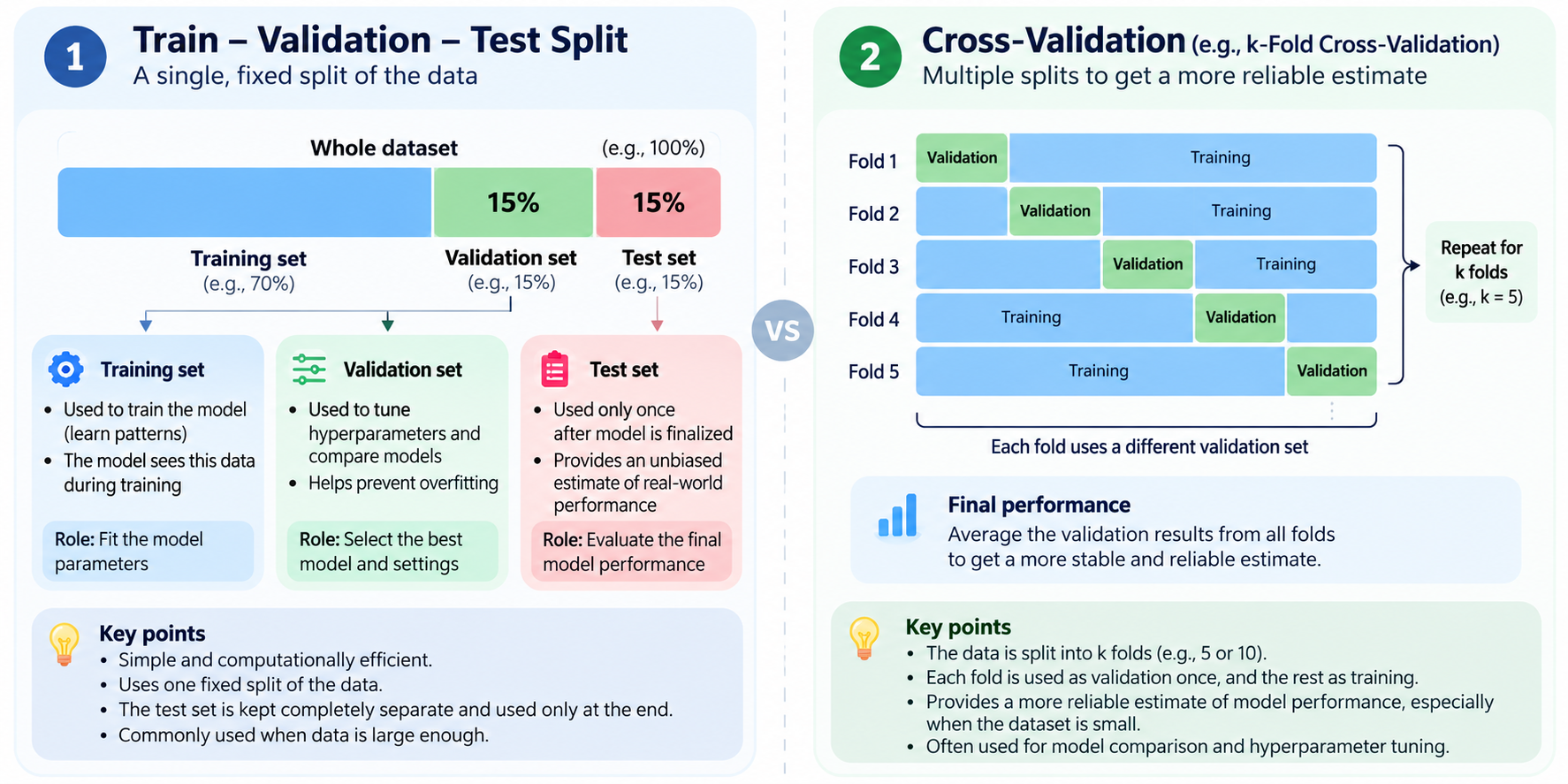
- A good \(k\) allows the model to generalize well to new data.
- We need to access the performance of our model on new data.
Classification metrics
- These are some common metrics in classification problems.
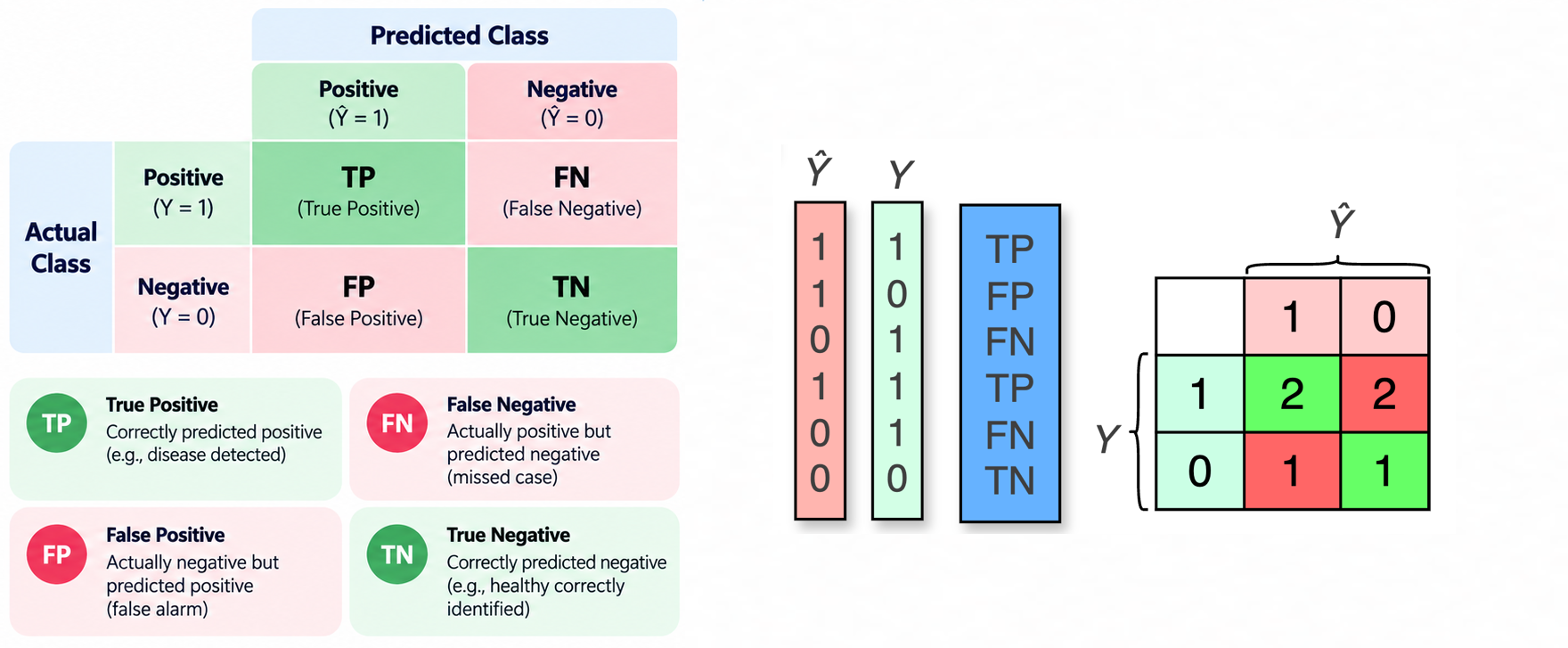
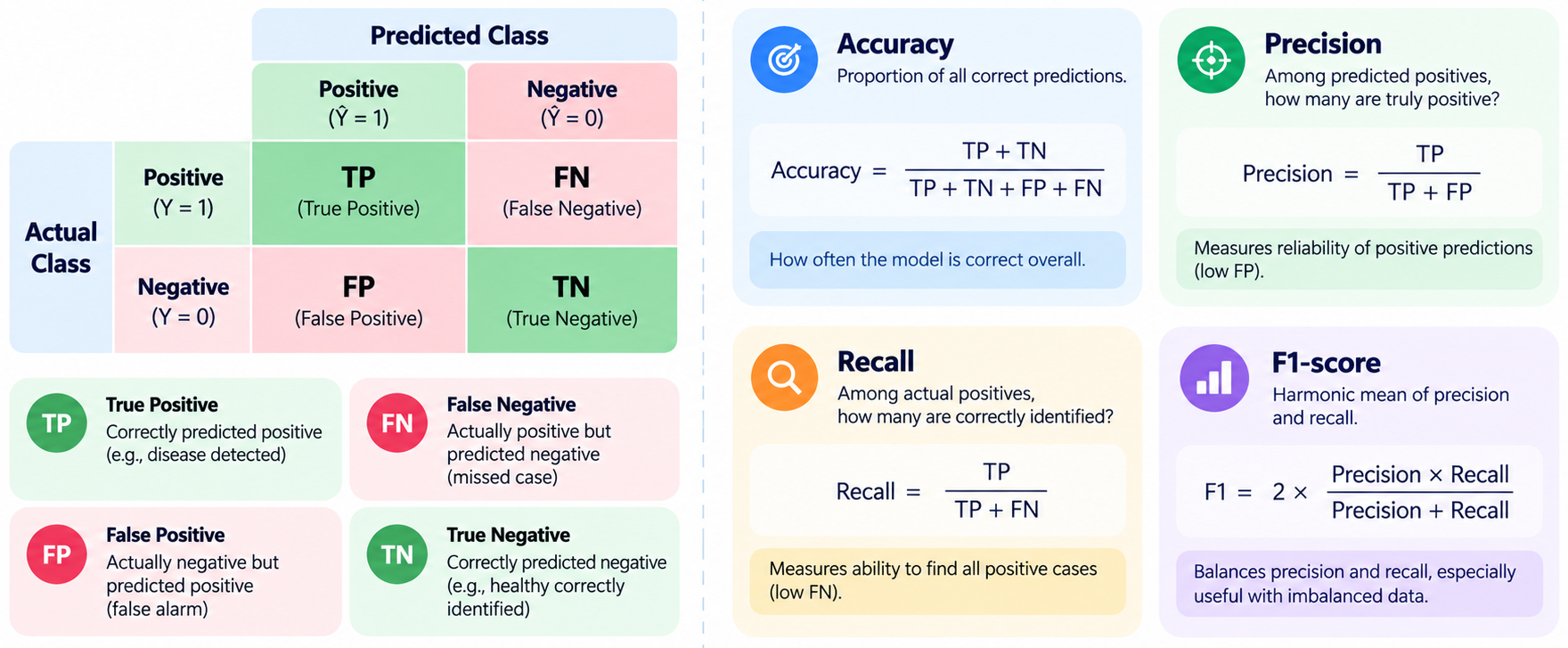
- According to the problem: \(\displaystyle F_{{\color{red}{\beta}}}=\frac{(1+{\color{red}{\beta}})\text{Precision}\times\text{Recall}}{{\color{red}{\beta}}\text{Precision}+\text{Recall}}, {\color{red}{\beta}}\geq 0\).
Parameters-Loss, Hyperparameters-Metrics
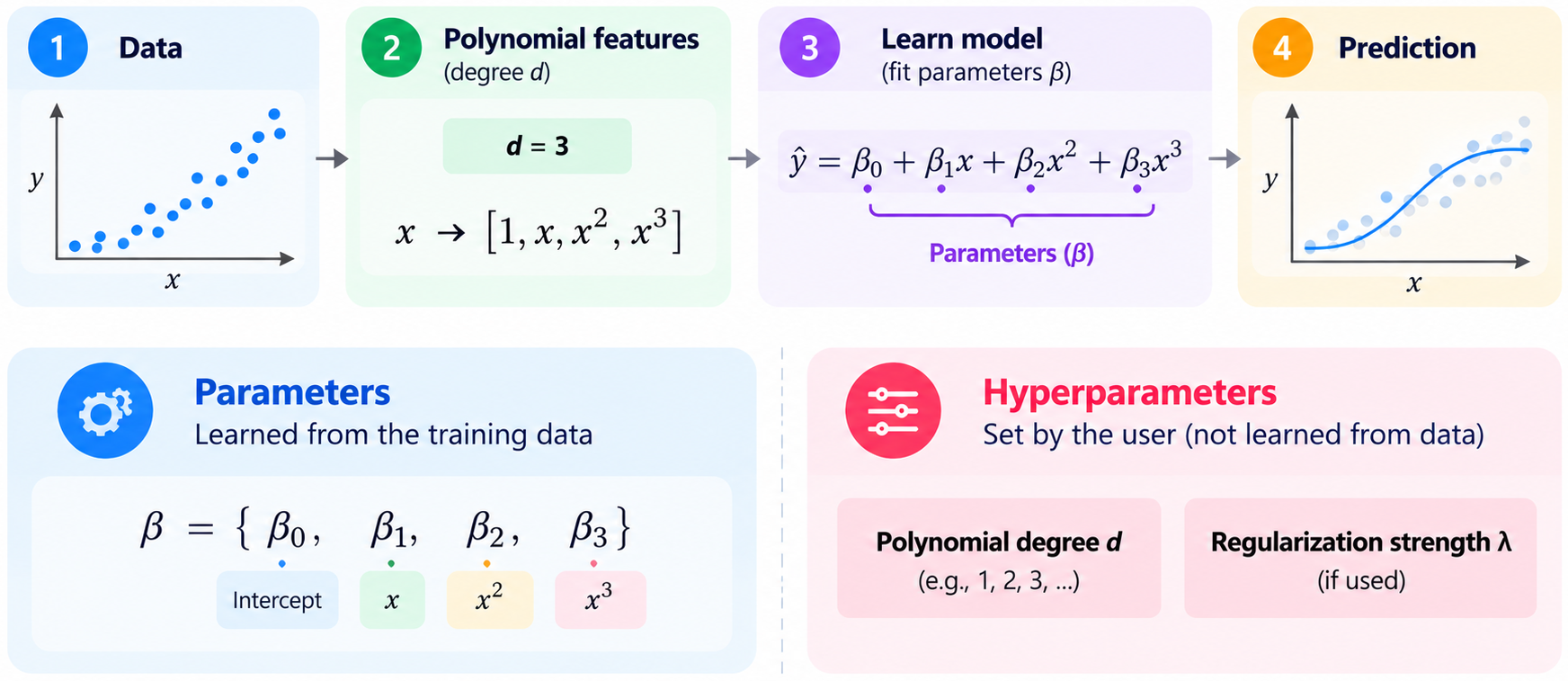
Parameters vs Hyperparameters
- Parameters: The key variables that the model learns from the data directly by minimizing loss function during training. Ex: in linear regression: \(\widehat{y}={\color{blue}{\beta_0}}+\sum_{j=1}^d{\color{blue}{\beta_j}}\text{x}_j\), the parameters are \({\color{blue}{\beta_j}}\).
- Hyperparameters: The variables that has to be set before the training starts. They are not learned directly from the data but fine-tuned using metrics with data-splitting methods such as cross-validation. Ex: in kNN, \(k\) is a hyperparameter.
What can go wrong?
- It’s because of the duplicated data!
- Let’s try again.
| Accuracy | Precision | Recall | F1-score | |
|---|---|---|---|---|
| 5NN | 0.868293 | 0.861111 | 0.885714 | 0.873239 |
| 1NN | 1.000000 | 1.000000 | 1.000000 | 1.000000 |
| 16NN_No_Dup | 0.885246 | 0.882353 | 0.909091 | 0.895522 |
4.1 Motivation
- kNN defines
Neighborsbased on a distance between two points. - The main question:
Is there other way to define Neighbor?

| x1 | x2 | y |
|---|---|---|
| -0.752759 | 2.704286 | 1 |
| 1.935603 | -0.838856 | 0 |
| -0.546282 | -1.960234 | 0 |
| 0.952162 | -2.022393 | 0 |
| -0.955179 | 2.584544 | 1 |
| -2.458261 | 2.011815 | 1 |
| 2.449595 | -1.562629 | 0 |
| 1.065386 | -2.900473 | 0 |
| -0.793301 | 0.793835 | 1 |
| 2.015881 | 1.175845 | 0 |
| -0.016509 | -1.194730 | 0 |
CART (cont.)
- At the 1st split, we compute IM (enptropy):
- 1st region: \(\text{En}(R_1)=-1\log(1)=0\).
- \(\begin{align*}\text{En}(R_2)&=-\color{blue}{16/19\log(16/19)}-\color{red}{3/19\log(3/19)}\\ &=0.436.\end{align*}\)
- \(\text{En}_1=(0)11/30+(0.436)19/30=0.276.\)
- Information gain: \(\text{En}_0-\text{En}_1.\)
- When any feature is used to split the data, this gain is counted as its usefulness.
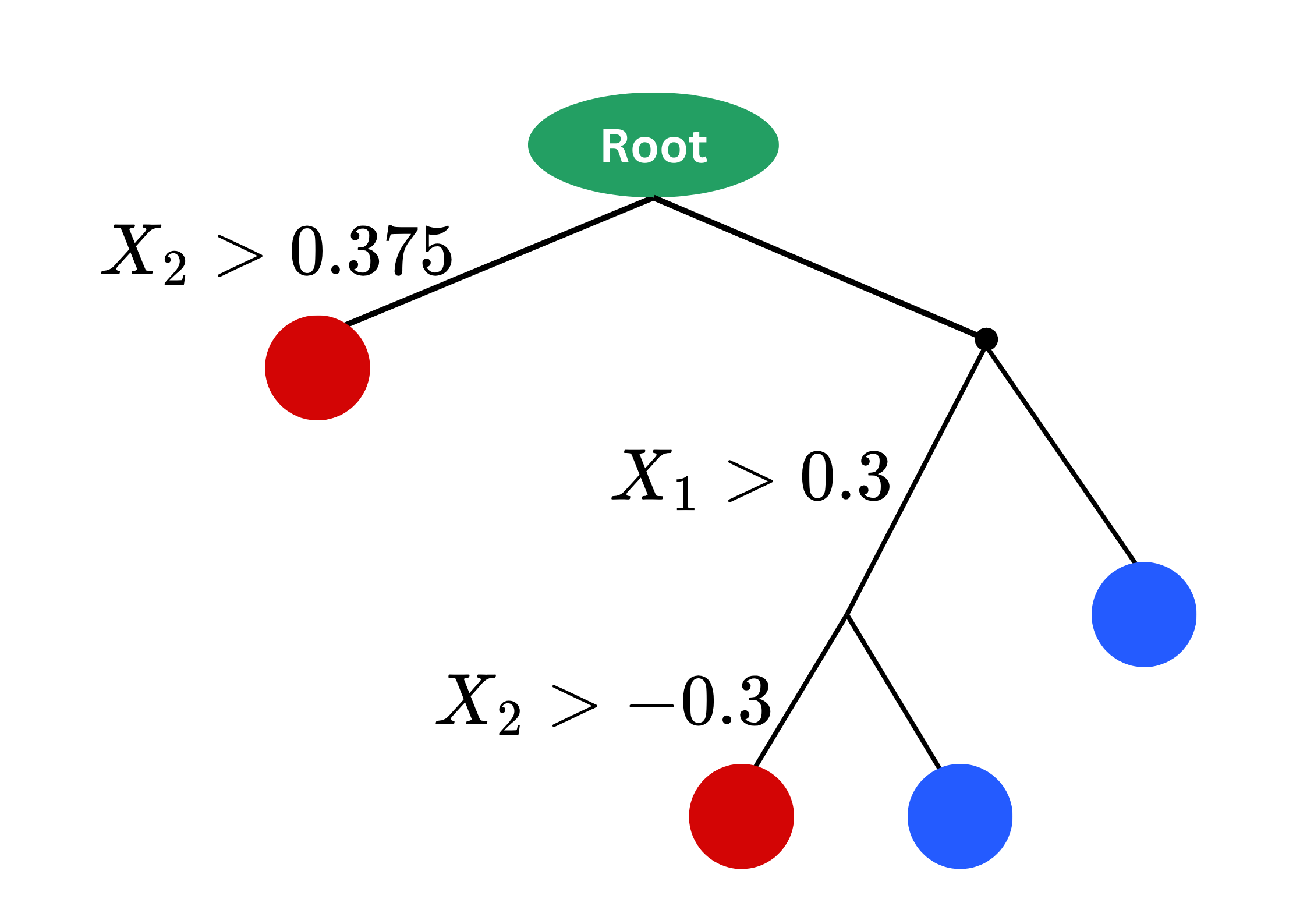
- Prediction rule:
- Regression: \(\color{blue}{\hat{y}}=\) average targets within the same block.
- Classification: \(\color{blue}{\hat{y}}=\) majority vote among points within the same block.
Hyperparameters of CART and Influence
Hyperparameters:max_depthmax_featuresmin_samples_splitmin_samples_leafcriterion… [see explanation here]
- Deep trees \(\Rightarrow\) Overfitting.
- In this case of smaller leaves, it’s similar to smaller \(k\) in \(k\)-NN.
- These hyperparameters should be fine-tuned using CV to optimize its performance.
